
How the Carteret County Court Calendar Works
Carteret has four practical date channels: the Case Summary/Register of Actions, Portal Search Hearings, the county's posted civil and criminal calendars, and the clerk or courtroom channel. Each can answer a different question. A Case Summary shows case-specific public activity. Search Hearings is the current location-and-time search. A local calendar gives session or published-calendar context. The clerk resolves a conflict or uncertainty.
Use the Carteret local administrative schedules page for its Civil Calendars and Criminal Calendars links. It also routes visitors to Superior Court spring and fall calendar material. A term calendar does not establish that every individual case remains set at the listed time.
Carteret Portal Hearing Searches
Portal Search Hearings is the statewide current-calendar tool for Carteret. It requires Location, Hearing Type, Search Type, the matching criterion, Date From, and Date To. Search types are case number, party name, business name, attorney name, attorney bar number, judicial officer, and courtroom.
| Control | Use for Carteret hearings |
|---|---|
| Location and hearing type | Select Carteret and the relevant type before the query. |
| Search type | Choose the field that matches the case, party, attorney, officer, or room. |
| Date From and Date To | Both are required for the current hearing range. |
| Courtroom | The statewide selector is broad; choose a precise room when known. |
Portal results provide hearing locations and times, but the state FAQ says they do not say whether a hearing is virtual or in person. Check any linked information and confirm uncertain logistics with the correct clerk or courtroom.
Carteret County Court Date Lookups
Keep the case or citation number from the notice if possible. Start with Smart Search and Carteret location, then open the Case Summary. Read the newest Case Event, the Hearings section if present, and any disposition. A past event shows history. It is not necessarily the next court date.
- Use Smart Search with the case number, citation number, or party name and add Carteret location.
- Read the latest Case Event and available Hearings section.
- Run Search Hearings with a current date range and a matching search type.
- Check the current Carteret civil or criminal calendar for published session context.
- Call Criminal at 252-504-4444 or Civil at 252-504-4422 if the notice conflicts with current information.
Carteret Criminal Calendar Call
The Carteret backlog-reduction plan describes local term practices. On the first day of a criminal trial term, defendants on the trial calendar and attorneys generally attend calendar call at 10:00 a.m. unless excused by the district attorney. Guilty pleas and motions follow, and matters not reached may be scheduled later in the term.
The same plan describes a jail-case-review calendar at 2:00 p.m. Wednesday of each criminal administrative term. Those details add context to a current court schedule. They do not replace the case-specific hearing return or a clerk confirmation.
The Carteret backlog-reduction plan is the official local source for these practices.
Court Settings: What Each Field Means
A Carteret hearing return should be read as a current calendar result, not a guarantee of every logistical detail. The date range and chosen search type shape what appears. For the order in which a judge calls a list, the Portal guide says to work with the courtroom clerk because that practice varies.
| Date and time | The current hearing return supplies the location and time when the query finds a setting. |
|---|---|
| Location and courtroom | Use the selected Carteret location and specific courtroom where known. |
| Hearing type | A required Search Hearings control; the state list is dynamic. |
| Judicial officer | A selectable search route, not a promise that a particular officer will hear every matter. |
| Case context | Read the Case Summary event timeline with the hearing result. |
Carteret Civil Calendar Practice
The locally posted civil plan says a Trial Court Coordinator administers Superior civil case management, a scheduling notice follows 120 days from filing, and a final trial calendar is published four weeks before a civil session. It also describes cases generally listed oldest-numbered first after priority and peremptory matters.
The historic plan says a printed civil motion calendar is posted at least two business days before session and calendar call begins at 10:00 a.m. first day. Confirm current practice through the current local schedules page, not historic contacts or a past docket event.
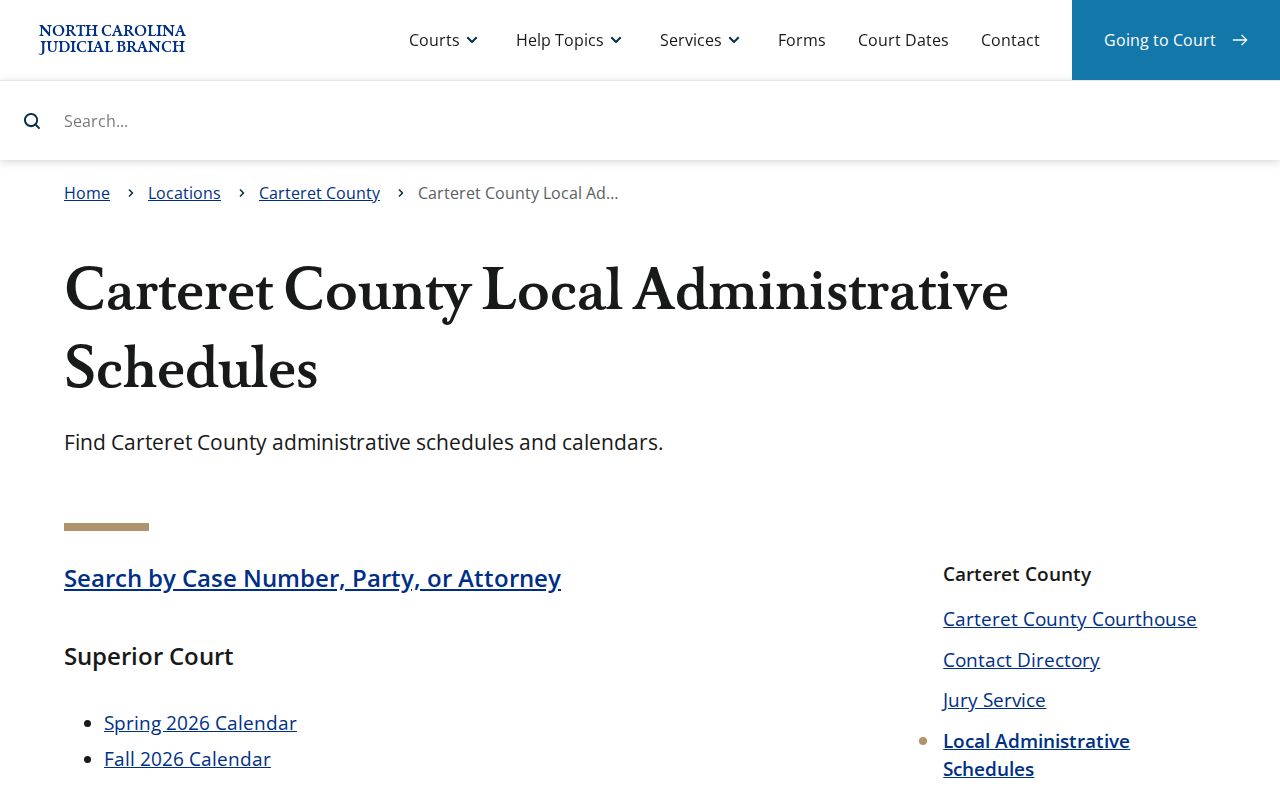
The official Carteret calendar route remains useful for checking a published civil or criminal session alongside the case-specific search.
When a Court Date Moves
A continuance is the practical word for a moved setting. Portal can also show case-type-specific event or status language, including Pending, Stayed, Transferred, Remanded, or Reopened. A historic setting remains part of the record even when a later event changes the operational date.
Read the newest hearing or event, run Search Hearings for a narrow current range, check the published calendar, and call the matching Carteret division before relying on an earlier notice. The research did not confirm a fixed countywide continuance deadline, a blanket remote-hearing policy, or an exhaustive calendar-publication rule.
Carteret Court Dates Are State Court Dates
Carteret municipalities do not operate separate municipal-court dockets. A Morehead City or Beaufort administrative contact is not the court-date channel for a North Carolina state-court case. The relevant route is the eCourts Portal, Carteret local calendar, clerk division, or courtroom identified by the current calendar.
That distinction matters when a notice relates to a traffic, criminal, civil, estate, or small-claims matter. Search the Carteret state-court record rather than relying on city hall hours, a local police contact, or a town permit calendar. The local rules page supports that Carteret route.
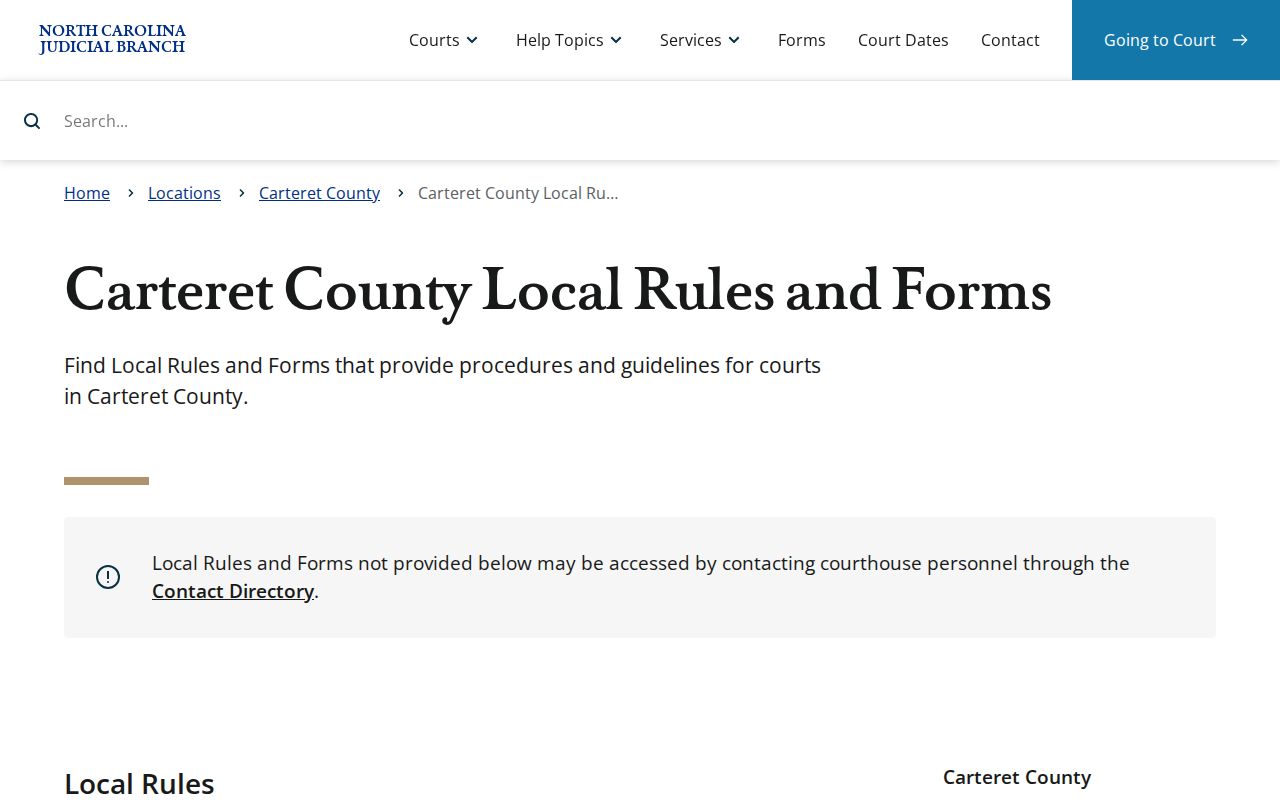
Local rules and schedule resources support the court-calendar channel but cannot substitute for a current individual hearing confirmation.
Carteret Courtroom Result Sorting
For a one-day courtroom search, Portal allows a returned case list to be sorted with arrows on its column headers. That can help organize a current Carteret hearing return, but the published training material does not state a universal call order. Judges and courtrooms can call cases differently.
Use the selected courtroom, current date range, and case number to check the result. Then ask the courtroom clerk about the expected call list or arrival logistics. A calendar result identifies a public setting, while local staff can explain how that particular courtroom handles the docket.
Missed Settings and What Comes Next
A missed traffic or infraction setting can be marked called and failed. State material says that after 20 days an FTA may be issued and the court can notify DMV if the matter remains unresolved. Depending on the circumstances, an FTA can lead to an arrest order or bond forfeiture. A judge may sometimes strike an FTA and give a new date, but that is not guaranteed.
Missed a Carteret setting? Confirm the current case status promptly through the Case Summary and the appropriate Carteret clerk division.
Use the case or citation number, ask about the current setting, and follow any court direction that applies to the matter.
Do not assume an older notice or a calendar return resolves a failure-to-appear entry.
Carteret date checks should stay within Carteret court channels: the Carteret Case Summary, Carteret Search Hearings, the Carteret calendar, and the Carteret Clerk. A Carteret criminal date and a Carteret civil date can use the same Carteret location while requiring the correct Carteret division for confirmation.
Carteret Criminal, Carteret Civil, and the Carteret courtroom channel each help resolve a Carteret setting question. A Carteret notice, Carteret Portal result, Carteret hearing return, and Carteret posted calendar can reflect different stages of a Carteret case. The newest Carteret information is the practical Carteret schedule answer.
Carteret calendar call practice is Carteret administrative context, not a replacement for a Carteret individual setting. Carteret continuances, Carteret closures, Carteret courtroom changes, and Carteret hearing logistics should be checked with current Carteret court staff. Carteret state-court dates do not route through Carteret municipal offices.
For a missed date, Carteret case details, Carteret current status, Carteret clerk confirmation, and Carteret court direction matter. Carteret Search Hearings and a Carteret Case Summary are useful, but the Carteret Clerk provides the local Carteret fallback when a Carteret date remains uncertain.